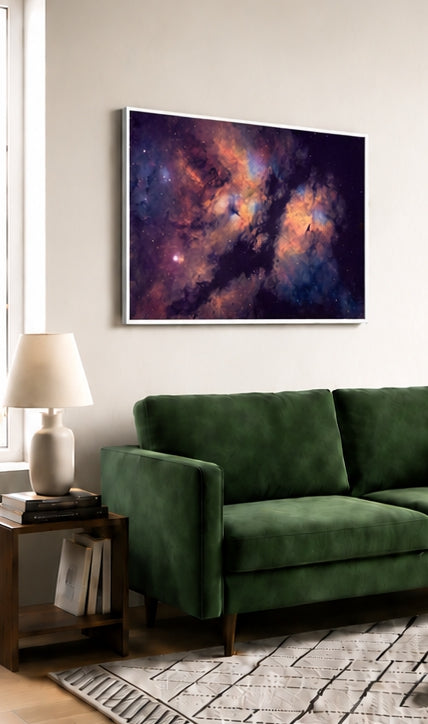
Butterfly Nebula
Butterfly Nebula
Couldn't load pickup availability
Butterfly Nebula
A photograph created from hours spent under the night sky
14 hours of exposure · 3 nights of imaging · 40 hours spent creating the final image
Four finishes to suit your interior
Classic Poster Print
- Practical, affordable, and securely packaged, it is ideal for smaller budgets.
Eco-friendly FineArt Print
- Premium printing on 200 gsm (200 g/m²) paper, rigid and 0.26 mm thick.
- Sustainable and environmentally responsible, certified FSC (Forest Stewardship Council).
Matte Aluminum Dibond
- Rigid and durable, with a matte finish that reduces reflections and helps preserve the details of the background sky and the fine structure of the stars.
Eco-friendly Gallery Print with white wooden frame and protective glazing
- Ready to hang directly on the wall.
- Printed on premium 200 gsm (200 g/m²) paper, rigid and 0.22 mm thick. Sustainable and environmentally responsible, certified FSC (Forest Stewardship Council).
- Presented in a white wooden frame and protected by shatterproof Plexiglas.
Every print is ready to be installed
- Wall mounting kit adapted to the chosen medium included
- Premium full-bleed printing on FSC-certified paper
- Made to order
- Printed as close as possible to the place of order
An original photograph captured and processed by Astro Artisan.
In the constellation of Cygnus, at the heart of one of the richest regions of the Milky Way, lies a vast complex of gas and dust known as the Butterfly Nebula, or IC 1318.
This region extends around Sadr, one of the brightest stars in Cygnus. The immense clouds of gas surrounding it are illuminated by nearby stars and reveal, through the lens, a spectacular web of filaments, dark clouds, and luminous structures.
Each stage of the processing allowed the contrasts, colors, and details to be refined in order to highlight the different layers of gas that make up the nebula, while preserving the richness of the surrounding star field.
From Light to Image
The numerous exposures are first calibrated and then combined to accumulate their signal and progressively reduce noise. This process reveals details that would remain invisible in a single photograph.
A long processing phase then follows, during which the different elements of the image are carefully refined: contrast, colors, brightness, nebula details, and balance with the surrounding star field.
For this image, I sought to convey the full richness of IC 1318 without losing the fine structures that give the nebula its distinctive character. The luminous regions and dust clouds were carefully processed to preserve this sense of depth and dimension.
A window onto a region of the Milky Way that we could never observe in this way with the naked eye.
An original astrophotograph, captured and processed by Astro Artisan Art.
Partager